Moving with kids? Here’s how the ‘proportion of children’ filter helps you find an area where family life actually works.
Oxford has world-class schools.
Parts of it have surprisingly few children.
At first glance, that sounds impossible. How can one of England’s most academically respected cities have areas where family life feels almost absent?
The answer is demographics.
When families move house, they usually begin with school catchments. Which primary feeds which secondary. Whether the Ofsted rating is strong. Whether they fall inside the admissions boundary.
All of that matters enormously. But it is only one part of what makes an area genuinely work for family life.
Because schools do not exist in isolation.
The nurseries, playgrounds, after-school clubs, sports groups, child-friendly cafés and day-to-day rhythms of family life all tend to follow one thing: where children actually live.
And that is where demographic data becomes incredibly useful.
In some parts of Oxford, high-earning academic and professional households without children have concentrated over time. The result is beautiful streets, exceptional education levels and extremely high property prices – but surprisingly low proportions of children living locally.
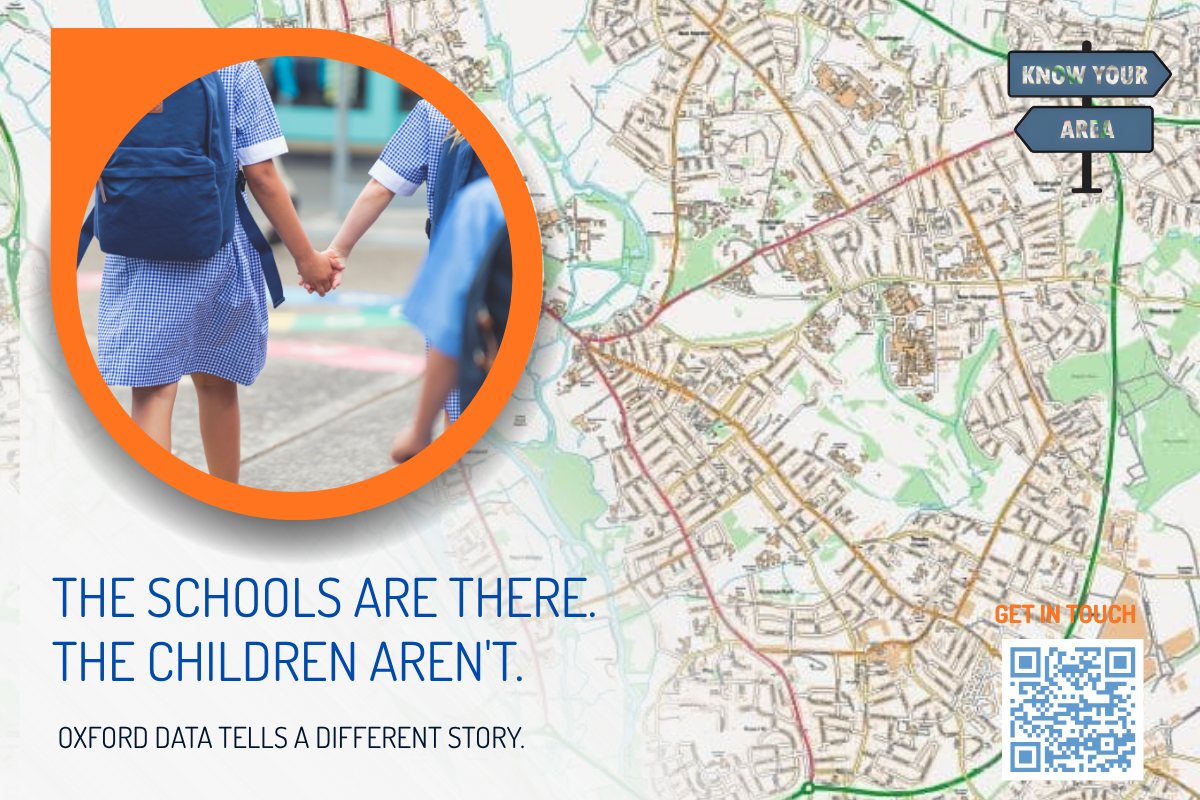
The schools are there.
The children often are not.
That changes the feel of an area more than people realise.
Family infrastructure grows where there is enough family demand to support it. Areas with high proportions of children tend to have more parks, more playgroups, more sports clubs, more buggy-filled cafés and more parents building communities around each other.
You can often feel it immediately.
Children cycling on pavements. Parents chatting outside schools. Weekend football sessions in the park. Birthday party venues fully booked months ahead. The everyday signs that family life is embedded into the area itself.
Meanwhile, an area with fewer children may feel quieter, older or more transient – even if the schools themselves are excellent.
Neither is automatically “better”. They simply support different lifestyles.
This is exactly why the “proportion of children” filter inside the KYA Spotlight can be so powerful for families planning a move.
Instead of relying purely on school catchment maps or estate agent descriptions, you can start exploring where family life is already concentrated.
Imagine a family relocating to a completely new city.
They have two children, a budget to stick to and only a limited understanding of which neighbourhoods truly work for day-to-day family life. On paper, dozens of areas may appear suitable.
But once they activate the children proportion filter inside the Spotlight, the picture changes.
Certain suburban areas begin to light up dark purple – places where higher proportions of children overlap with lower crime, strong broadband and realistic house prices. Suddenly, they are not just looking at houses. They are looking at environments built around families already living there.
And sometimes the results are surprising.
Areas with excellent reputations are not always the areas with the strongest family demographics. Equally, some quieter outer suburbs may reveal themselves as deeply family-oriented communities once the data becomes visible.
The filter also works the other way around.
Areas with very high proportions of children often come with more competitive school catchments because demand for places is naturally higher. Oversubscription becomes more common. Distance-based admissions become tighter.
That nuance matters.
The goal is not simply to find “the most children”. It is to understand the broader shape of the area and how it aligns with your family’s priorities.
That is why the Spotlight works best when multiple layers combine together:
- proportion of children
- house price range
- crime percentile
- broadband coverage
- employment levels
- deprivation data
What emerges is not just a list of properties. It is a shortlist of places where family life is genuinely more likely to work.
Because when you move with children, life happens far beyond the front door.