Why the Average House Price Doesn’t Tell You the Whole Story
The Average Price Is Useful. But It Isn’t the Price of Your Street.
You’re searching for somewhere to live and find the figure you’ve been looking for:
“Average house price in the area: £350,000.”
Useful? Absolutely.
The whole story? Not even close.
An average house price can give you a quick indication of the overall property market in a town, postcode district or wider area. But when you’re deciding where to spend hundreds of thousands of pounds, averages can hide some of the most important differences.
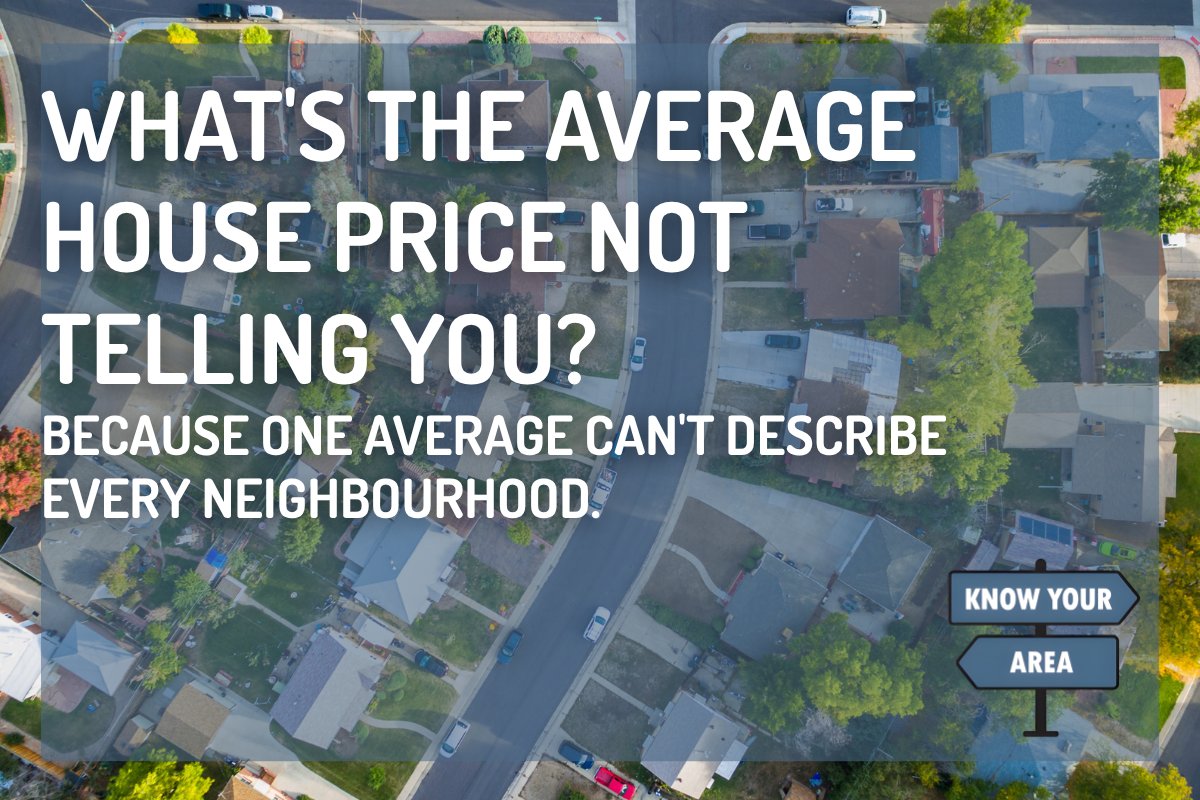
Property prices can change considerably from one neighbourhood to another – and sometimes over surprisingly short distances.
That’s why understanding where prices change can be far more revealing than simply knowing the average.
What Does an Average House Price Actually Tell You?
At its simplest, an average combines a collection of property prices into one figure.
That makes it useful for getting a broad sense of a market.
But think about the properties that might sit behind that number.
One part of a town could contain large detached family homes.
Another might be dominated by terraces.
Another could contain new-build apartments.
Another might have significantly lower-priced housing.
Combine them and you get an average.
But that average doesn’t necessarily describe any one of those neighbourhoods particularly well.
When you’re actually choosing a home, it’s the local differences that matter.
Property Markets Aren’t Uniform
It’s tempting to think of somewhere as having a single property market:
“House prices in Bristol.”
“Average property price in Sheffield.”
“House prices in Cornwall.”
But towns, cities and counties aren’t one homogeneous market.
They’re collections of neighbourhoods, streets and communities, each influenced by different factors.
Prices can vary according to things such as:
• Property type
• Local schools
• Transport connections
• Access to amenities
• Crime
• Flood risk
• Local environment
• Housing demand
• Affordability
• The character of individual neighbourhoods
That’s why two properties relatively close to one another can sit in very different local markets.
The Map Can Tell You What the Average Can’t
This is where looking at property information geographically becomes particularly valuable.
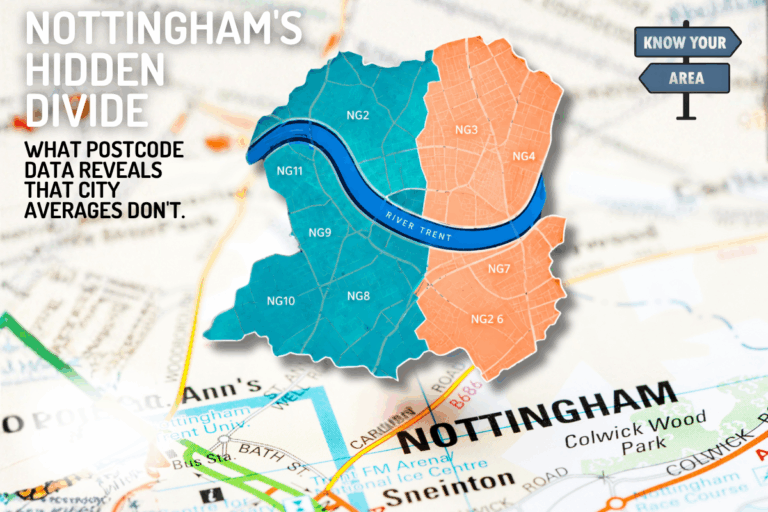
Instead of seeing one number representing an entire area, a map allows you to see how prices change as you move through it.
You may spot:
• Higher-value pockets
• More affordable neighbouring areas
• Sharp changes between adjoining locations
• Areas that appear very different from the wider town average
Suddenly, you’re not just asking:
“What’s the average house price here?”
You’re asking:
“What’s happening around the property I’m actually considering?”
That’s a much more useful question for a buyer.
A Few Streets Can Make a Difference
House hunters often begin with fairly broad searches.
A town.
A village.
A postcode district.
But once you’ve narrowed your search, the research needs to become more detailed.
Imagine you’ve found two suitable homes a short distance apart.
They’re similar in size.
They both work for your commute.
Both are within budget.
But one sits within a noticeably higher-value pocket while the other is surrounded by considerably more affordable housing.
That doesn’t automatically make either property the better choice.
But it’s information you’d probably want before deciding between them.
Hyperlocal context helps you understand what you’re actually buying into.
Don’t Look at House Prices in Isolation Either
There’s another important point.
Even detailed property-price information is still only one part of the picture.
If prices change noticeably between neighbouring areas, you may want to understand what else changes with them.
What are the schools like?
How does crime compare?
Is there a difference in flood risk?
What about broadband connectivity?
Healthcare?
Local demographics?
Environmental factors?
There may not be one simple explanation for a price difference, and correlation doesn’t necessarily mean causation. But exploring multiple datasets can give you far more context than a house-price figure alone.
That’s one of the benefits of researching an area geographically.
You can start asking why different places look different.
Compare Affordability, Not Just Price
There’s also a difference between property price and affordability.
A lower-priced area isn’t necessarily more affordable for the people who live there, just as a higher-priced area doesn’t automatically tell you everything about local economic circumstances.
Looking at affordability information alongside property prices can add another layer of understanding.
Again, the point isn’t to identify a universally “good” or “bad” area.
It’s to understand the differences and decide what matters to you.
See Property Data on the Map
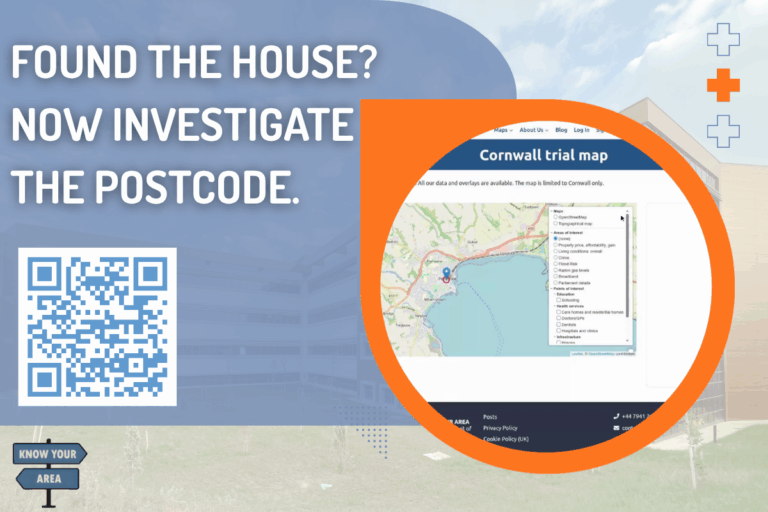
Rather than relying on a single headline figure, Know Your Area allows you to explore property information geographically and see how the picture changes across neighbouring locations.
You can then bring other information onto the map to put those property prices into wider context.
See how Know Your Area’s map layers bring different datasets to life and allow you to explore how information changes geographically.
Watch on YouTube: https://www.youtube.com/watch?v=kWnu50PVhT0&t=1s
The value isn’t simply having more data.
It’s being able to see the relationships, differences and patterns that a single average can hide.
What Should You Research Alongside House Prices?
Before buying, consider looking at property prices alongside:
• Crime
• Schools and Ofsted ratings
• Flood risk
• Broadband connectivity
• Healthcare facilities
• Demographics
• Deprivation
• Environmental factors
• Local infrastructure
You might discover that the area you originally chose is exactly right for you.
Or you might find another location nearby that offers a better combination of property, price and lifestyle.
Either way, you’ve made the decision with more information.
Research the Area Before You Fall for the House
There’s a reason house hunting can become emotional.
You walk through the front door and immediately start imagining your life there.
Where the sofa will go.
Which bedroom the children will have.
What you’ll do with the garden.
That’s completely natural.
But before emotion takes over, take some time to research what’s outside that front door too.
Look beyond the asking price.
Look beyond the town average.
Look at the neighbourhood.
Look at the surrounding streets.
Compare.
Explore.
Ask questions.
Because an average can tell you something about the market.
It can’t tell you the whole story of the place you’re about to call home.
Frequently Asked Questions
Are average house prices useful?
Yes. Average house prices can provide a useful broad indication of a property market. However, they should ideally be used as a starting point rather than the only measure when researching a particular property or neighbourhood.
Why can house prices vary so much within the same town?
Neighbourhoods differ in property types, demand, schools, transport, amenities, environment and many other characteristics. This means local property markets can vary considerably even within the same town or city.
Should I research house prices by postcode?
Looking at smaller geographical areas can provide more relevant context than relying solely on a town-wide or regional average. Mapping the information can also help reveal how values change between neighbouring locations.
What else should I check before buying a house?
Consider researching crime, schools, flood risk, broadband, healthcare, demographics, affordability and environmental information alongside property prices.
How Know Your Area Helps
Know Your Area brings extensive UK location data together within one interactive platform, allowing you to research the area surrounding a property, rather than relying on one headline statistic.
Explore property prices and affordability alongside information covering crime, schools, healthcare, flood risk, broadband, demographics, deprivation, environmental factors and much more.
Instead of opening multiple websites and trying to piece the information together yourself, you can explore how different datasets change geographically.
For £49.99 for 12 months’ access, you can research and compare the locations you’re considering throughout your property search.
Before you buy the house, know the area.