How to Research Any Postcode Before Buying a House
You’ve found the house.
The kitchen is perfect. The bedrooms work. The garden is bigger than you expected.
You’ve checked the commute and maybe driven around the area once or twice.
But how much do you really know about the postcode you’re about to move to?
When buying a house, most people spend hours researching the property itself. They study floor plans, compare mortgage rates, check the boiler and debate whether they’ll need to replace the bathroom.
The wider area often gets far less scrutiny.
And yet you can change a kitchen.
You can’t move the house.
Before committing to one of the biggest purchases you’ll ever make, researching the postcode and surrounding area can help you build a much clearer picture of what living there might actually be like.
And that means looking at more than one piece of information.
Watch: How to Put Area Data Together Before You Buy Here
Searching for a postcode is only the starting point.
In this video, we show how Know Your Area can be used to search a location, explore the available data, compare property prices and start narrowing down the areas that do-or don’t-match what you’re looking for.
The important part isn’t one individual statistic.
It’s what happens when you start putting the information together.
Start with the postcode-but don’t stop there
You probably already have a starting point.
It might be the postcode of a house you’ve found online.
A town you’re considering moving to.
An area near a school.
Or somewhere within commuting distance of work.
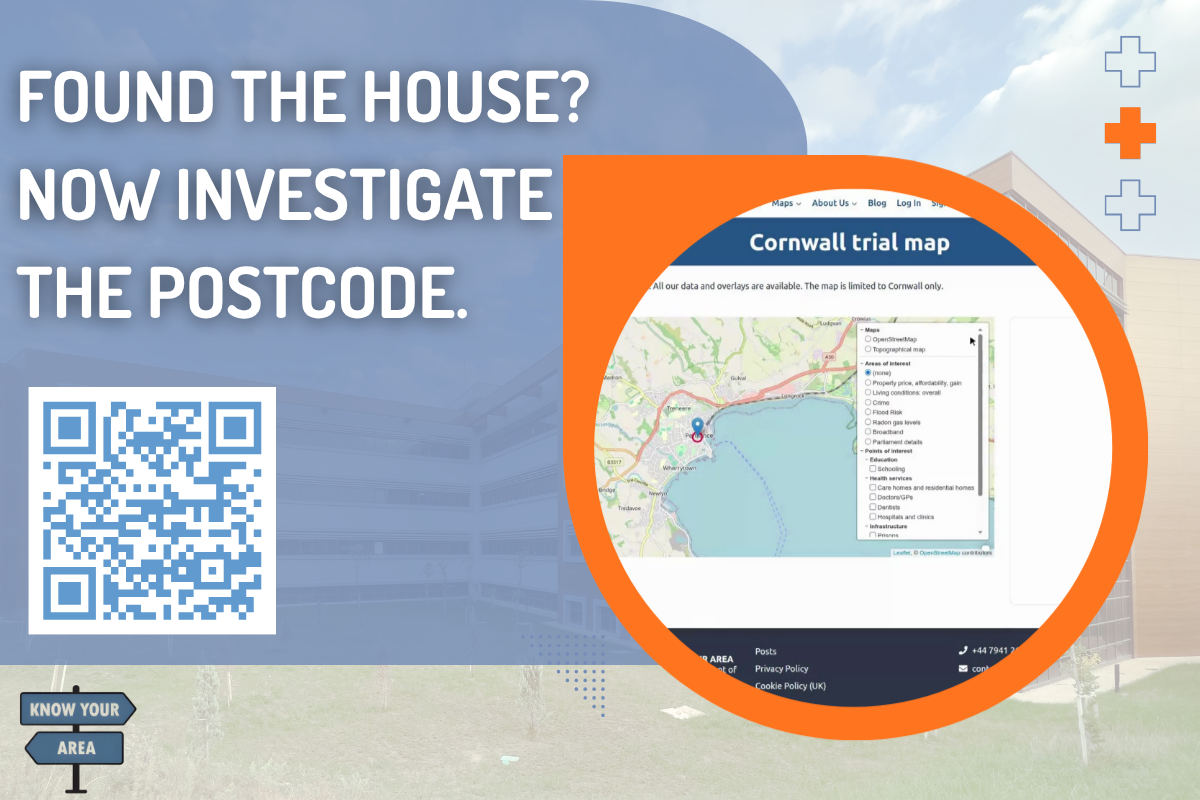
Search for that location in Know Your Area and you can begin exploring the surrounding map.
But here’s the important part:
Don’t just look at the postcode you searched.
Zoom out.
Move around.
Look at the neighbouring areas.
Averages can hide significant local differences. When information is viewed geographically, you can start to see where the picture changes.
Your original postcode is the starting point.
The surrounding area provides the context.
Check the property price picture
The asking price tells you what the seller hopes the property is worth.
It doesn’t necessarily tell you what is happening across the wider local property market.
Look beyond the individual listing.
How do property prices change across nearby areas?
Are neighbouring locations more or less affordable?
Can you see differences over a relatively short distance?
Know Your Area allows you to explore property price and affordability information geographically, helping you put the property you’re considering into a much wider local context.
You may even discover that moving your search slightly changes the type of property available within your budget.
Add the information that matters to you
This is where area research becomes personal.
Not every buyer is looking for the same thing.
For a family, schools and the proportion of children living locally might be important.
For someone working remotely, broadband connectivity could be a priority.
Other buyers may want to understand crime, flood risk, healthcare or the wider environment.
Know Your Area brings extensive UK location data into one interactive platform.
You can explore information including:
- Crime
- Schools and Ofsted ratings
- Living conditions
- Deprivation
- Healthcare and CQC ratings
- Property prices
- Affordability
- Property price rises
- Flood risk
- Broadband connectivity
- Age demographics
- Political landscape
- Landfill sites
- Prisons
- Power plants
- Radon gas levels
- And more.
The point isn’t that every buyer needs to obsess over every single data layer.
The point is that you can explore the information that matters to you.
See the data on the map
A list of statistics can tell you numbers.
A map can help you see the pattern.
Turn on the data you want to explore and look at how the picture changes geographically.
Take crime as an example.
A single figure for an entire town may not tell you where crime is concentrated or how one part of the area compares with another.
The same principle applies to property prices, living conditions, demographics and other location data.
By viewing information on a map, you can start to ask better questions.
Why does the picture change here?
What happens if I move my search slightly?
How does this area compare with the one next door?
This is where area research starts to become genuinely useful.
Use different data layers together
One of the biggest mistakes when researching an area is looking at one statistic in isolation.
A buyer might search:
“Is this a safe area?”
Another might search:
“Are the schools good?”
Or:
“What are house prices like?”
All reasonable questions.
But none of them tells you the whole story.
Instead, start layering your priorities.
Perhaps you want:
- Property prices within your budget
- Lower crime
- Nearby schools
- Good broadband connectivity
- Access to healthcare
As you explore different information, you can start to build a much more detailed picture of the locations you’re considering.
This is the real power of Know Your Area: not simply finding one statistic, but seeing multiple types of area data in geographical context.
Rule out areas that don’t match your priorities
Area research isn’t only about finding somewhere.
It’s also about knowing where not to spend your time.
If a particular factor is important to you, use the available data to investigate it before booking endless property viewings.
Perhaps broadband connectivity doesn’t meet your needs.
Perhaps you’ve identified a flood risk you want to investigate further.
Perhaps property prices move outside your budget.
Or perhaps the local characteristics simply aren’t what you’re looking for.
That doesn’t automatically make somewhere a “bad area”.
It may simply mean it isn’t the right area for you.
And discovering that before you’ve spent weeks viewing houses can save considerable time.
Compare before you commit
Once you’ve researched one location, compare it.
Look at the next postcode.
Move across the map.
Change the data layer.
Compare property prices.
Explore crime.
Look at schools.
Check broadband.
Investigate flood risk.
The more you explore, the more the geography of an area starts to make sense.
You may discover that the postcode you originally searched is exactly where you want to live.
Or you might find another location a short distance away that better matches your priorities.
That’s the value of researching the area before falling completely in love with the house.
One postcode. A much bigger picture.
Buying a house isn’t just about bedrooms, bathrooms and square footage.
You’re choosing the roads you’ll drive.
The schools you may use.
The services you’ll rely on.
The internet connection you’ll work from.
The wider environment around your home.
And the community you’re becoming part of.
Know Your Area brings extensive UK location data together in one interactive platform, allowing you to search, explore, layer and compare information about the places you’re considering.
No single statistic can tell you whether an area is right for you.
But putting the information together can help you ask better questions and make a more informed decision.
Before you buy the house, know the area.
For £49.99 for one year’s access, you can research the locations you’re considering and look beyond the property listing before making one of the biggest financial decisions of your life.
Explore Know Your Area and start with any postcode.